







LET’S TALK +1 855 908 0588

Dominate Web Search – Improve your GEO

Generative Engine Optimization

Our GEO Campaign can help you become the answer, not just another search result.

Get Discovered on Today’s

Leading AI Platforms

  • Chat GPT
  • Ai Google Overview
  • Claude
  • DeepSeek
  • Perplexity

Components of Effective GEO


To succeed with Generative Engine Optimization, your content needs to be intentionally crafted for AI engines like ChatGPT, Perplexity, and Google AI Overviews. GEO is about becoming the cited source for AI-generated responses. Integrating geo services as part of a comprehensive GEO strategy ensures your approach is future-proof and aligned with evolving AI-driven search results. Here’s how to structure and format content that AI tools understand, trust, and reference:

1. Direct Answer

Begin your content by clearly answering the core question or topic. AI search engines often pull citations from your opening sentences, so make your introduction count. For example, a piece titled “What is Local SEO?” should immediately define it in plain terms within the first paragraph.

2. Self-Contained Sections

Every H2 section should stand alone, meaning a reader (or an AI bot) should be able to understand the entire point without needing to scroll up. This technique, known as semantic chunking, increases the chance of section-level AI citations.

3. Consistent Data

AI engines favor fact-rich content. As a rule, aim to include one statistic, percentage, or data point for every 150–200 words of content and always link back to the original source. This builds credibility and improves citation chances in AI-generated answers.

4. Questions as Headers (H2s & H3s)

Format many of your subheadings as questions, this aligns your content with how users interact with AI search platforms and voice assistants. For example, instead of “GEO Benefits,” use “What Are the Benefits of GEO?”

5. FAQ Section

A strong FAQ section (with 5-10 common questions) helps capture long-tail search queries and voice search traffic. Keep answers concise (40-60 words) and formatted as standalone insights.

6. Schema Markup

Use proper structured data (schema) on every content piece to support AI parsing and classification: Article schema for blogs (include headline, author, publish date, and image) & FAQ schema for FAQ sections (question + answer pairs)

How to Dominate Modern Search

What is Generative Engine Optimization (GEO)?

Generative Engine Optimization (GEO) is the process of fine-tuning your website’s content so it can be found and quoted by AI-powered search tools like ChatGPT, Perplexity, Gemini, and Google AI Overviews. These platforms generate full answers for users and GEO helps make sure your content is included in those answers.

Unlike traditional SEO, which focuses on rankings, GEO ensures your content is readable, clear, and trusted by AI models. That means using smart formatting, accurate info, and structured layouts. As AI search tools quickly reshape how people find information, GEO is becoming essential. If your content isn’t built for AI, it may never show up, even when people are looking for what you offer.

What makes GEO different is how it speaks the language of large language models (LLMs). AI systems don’t rely on keywords alone, they need well-formatted, semantic, and factually sound content that aligns with how people ask questions naturally.In our evolving digital landscape, GEO has become a critical complement to traditional SEO: as more users turn to AI‑driven search tools for fast, conversational answers, implementing GEO helps ensure that your brand and expertise appear where people are actually looking.

How GEO Differs from SEO

While Search Engine Optimization (SEO) and Generative Engine Optimization (GEO) are both forms of search optimization aimed at increasing your visibility online, they’re designed for two very different search environments.

Traditional SEO focuses on ranking your website in search engine results pages (SERPs) like Google, Bing, and Yahoo. It uses tactics like:

  • Keyword targeting
  • Meta tags and descriptions
  • Link building
  • Long-form content
  • Technical site optimization

GEO, on the other hand, is built for AI-powered platforms like ChatGPT, Perplexity, Google SGE, and Claude, which don’t return links in the traditional sense. Instead, they generate ai outputs such as summaries, overviews, and conversational responses, often citing only a few trusted sources. On platforms like Google, the AI Mode feature presents AI-generated responses and overviews directly in search results, making it crucial for content to be optimized for inclusion in these formats.

That’s why GEO emphasizes:

  • Structuring content to be AI-readable
  • Starting with direct, concise answers
  • Semantic formatting (clear headings, standalone sections)
  • High fact density (1 statistic every 150–200 words)
  • Schema markup (especially Article and FAQPage)
  • Content freshness and authority

In SEO, the goal is to rank higher. In GEO, the goal is to be referenced inside the answer itself.

Aspect
SEO Audit
GEO Audit
Goal
Rank higher in Google search results
Be featured and cited in Al-generated answers
Content Focus
Keywords, meta tags, link building
Question-based formatting, factual authority, topical depth
Technical Focus
Crawlability, speed, mobile-friendliness
Same +Al crawler access and parseable structure
Authority Signals
Backlinks, brand mentions, domain authority
Entity recognition, citation frequency, schema alignment
Measurement
Rankings, traffic, leadsrized responses
Al citations, snippet inclusion, visibility in generative tools
Example Metric
Rank #1 for DUI lawyer Dallas
Mentioned in ChatGPT’s answer to “What’s the penalty for DUl in TX’

Why GEO Matters in 2025 and Beyond

The rise of generative‑AI search is already reshaping how people find information online, and Generative Engine Optimization (GEO) is the new competitive edge. According to a 2025 report, AI‑referred sessions surged by 527% between January and May 2025, reflecting a seismic shift in search behaviour. GEO enhances a brand’s visibility in AI-driven search environments, making it crucial for brands to be recognized and cited by AI platforms.
Most users no longer scroll through lists of links, they get answers directly from AI‑powered platforms like ChatGPT, Perplexity, Google Gemini, or Google AI Overviews. This shift means strong page rankings alone are no longer enough; if your content isn’t optimized for generative engines, it may never be surfaced. Maintaining a strong digital presence across both traditional and AI-powered platforms is now essential for ongoing discoverability.
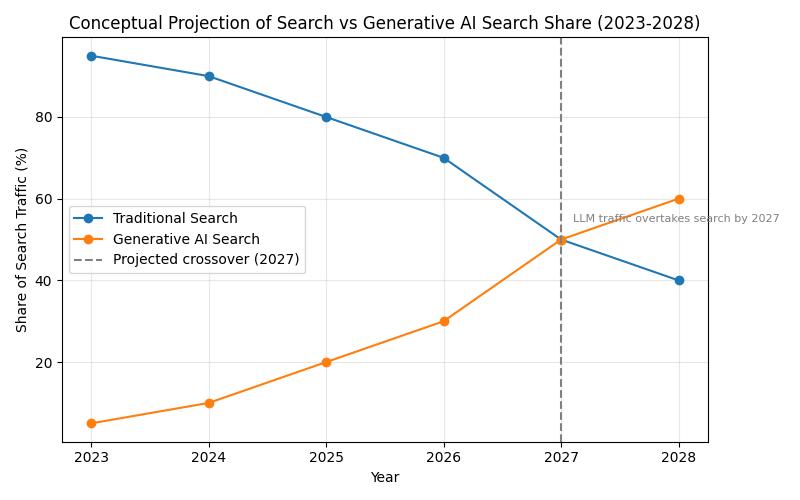
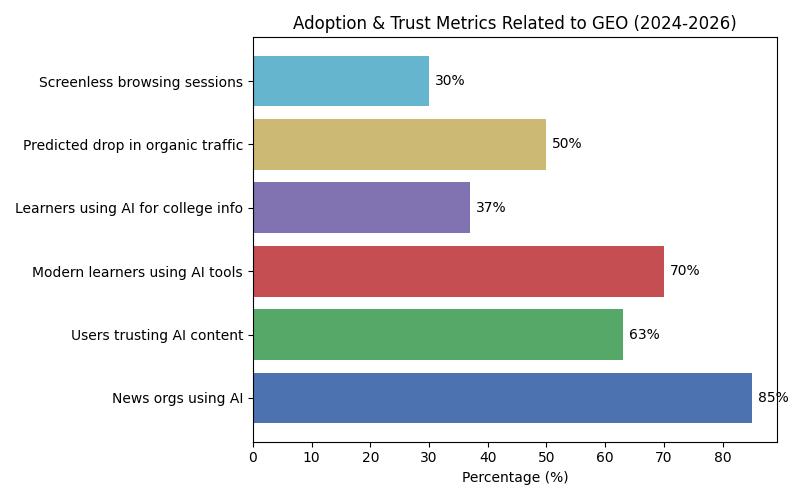
Google’s AI Overviews now appear in over 13% of search results, influencing billions of queries monthly. Gartner predicts traditional organic traffic could drop by 50% by 2028, with 30% of browsing sessions becoming screenless by 2026. According to Semrush, traffic from AI platforms like ChatGPT may surpass Google Search by 2027.


Generative AI is already widely adopted. Around 70% of learners use tools like ChatGPT, with 37% using them for education research. In 2025, 85% of news outlets used or tested generative AI, and 63% of users trusted AI-generated content from credible sources. Generative AI tools are key drivers of this change, shaping how content is discovered and cited. As zero-click searches rise, where users get answers without clicking links, GEO becomes essential, addressing both the growing opportunity and risk of AI-driven search.
The chart on the left side highlights key adoption and trust trends shaping the future of GEO.

Moreover, as generative search becomes mainstream, being featured as a cited source, not just another link is rapidly becoming a new standard for visibility and search rankings in both traditional and AI-powered search results. As one recent industry analysis puts it: “search engines are evolving, GEO is now a critical discipline for brands that want to remain discoverable in the AI‑driven world.”  Search optimization is evolving to include AI-driven approaches, requiring new tactics to maintain authority and visibility.
In short: in 2025 and beyond, GEO is a core part of digital marketing strategy.

Companies that adapt quickly and optimize for generative AI stand to capture the growing wave of zero‑click queries, voice‑search conversations, and AI‑generated summaries, ensuring their brand stays visible exactly where modern users are searching. Valuable content that provides direct answers is more likely to be cited in AI-generated responses, and tracking brand mentions across AI platforms is now a key metric for measuring influence. The evolution from SEO to GEO also includes answer engine optimization (AEO), which builds on SEO fundamentals while adapting to the unique demands of AI-driven engines.

GEO for Local Businesses & Service Providers

If you’re a local business or service provider, GEO is your next competitive advantage. With more people asking AI tools and voice assistants for recommendations (e.g. “best family lawyer near me” or “emergency HVAC Toronto”), your business needs to be the answer.

Traditional SEO helps you show up in search results. But GEO helps you get cited inside the AI-generated response, the very thing users read first, often without ever clicking a link. By structuring your content for AI, using local schema markup, and answering the right questions, you position your business to appear in AI summaries, voice search results and real-time answers right when potential customers are searching.

Get in touch

Most customers no longer scroll—they ask a question and rely on the instant answer. With GEO, your business becomes the source of that answer. By optimizing your content for conversational queries, structuring data for AI tools, and aligning with how voice assistants interpret intent, you position yourself to appear in zero-click results and spoken recommendations. This means you capture high-intent customers at the precise moment they’re searching, without needing a single click.

Get in touch

Stay Ahead of Local Competitors with GEO

Your competitors may be investing in traditional SEO, but few are optimizing for how AI actually delivers answers. GEO gives you a strategic edge by structuring your content so AI systems can recognize, trust, and surface your business ahead of others in your area. When customers search locally—whether through ChatGPT, Google’s AI Overviews, or voice assistants—your business becomes the one AI highlights first. 

Get in touch

Establish Credibility Inside AI-Generated Answers

AI tools prioritize sources they recognize as credible, consistent, and locally relevant. GEO helps you establish that authority by structuring your content so AI engines can easily interpret your expertise, validate your information, and cite you confidently in their responses. The more trust you build with these systems, the more frequently your business appears in AI-generated answers—positioning you as the go-to provider in your market before customers ever consider a competitor.

Get in touch

Generate High-Intent Leads Organically

GEO positions your business directly inside the answers people trust most—AI-generated recommendations. By appearing as the cited source when users ask specific, high-intent questions, you attract customers who are ready to take action without relying on costly PPC campaigns. Instead of paying for every click, you earn visibility organically at the exact moment someone is searching for your service. The result: more qualified leads, stronger conversion rates, and sustainable growth without the constant expense of paid advertising.

Get in touch

Strategic goals for CMOs and directors

Invest in structured content
and schema

Adopt headless CMS platforms and apply schema markup to articles, FAQs and how‑tos. Structured data helps AI models parse and reuse content.

Build
authority through expertise

Demonstrate E‑E‑A‑T by publishing expert‑authored content, citing credible sources and earning mentions on reputable platforms. Use public relations and influencer engagement to generate co‑citations.

Diversify strategic distribution channels

Engage in communities where AI models gather information:Reddit, LinkedIn, YouTube and podcasts. Encourage employees to participate in forums and professional networks.

Monitor
ongoing
AI
visibility

Implement analytics to track inclusion in AI answers, referrals from AI tools and sentiment of AI‑generated mentions. Tools such as Semrush’s AI SEO toolkit can benchmark LLM visibility.

What Makes dNovo the Right GEO Partner

Choosing the right partner is key to getting your business seen, here’s how dNovo Group stacks up:

dNovo Group

GEO-First Focus

We lead with GEO strategy ensuring your content is ready for AI-generated answers, summaries, and zero-click results across major platforms.

LLM-Friendly Content

Our content is structured for large language models (LLMs), with answer-first writing, semantic formatting, and reliable, factual information.

Advanced Schema Integration

We implement and validate advanced schema types like Article, FAQ Page, and Local Business to enhance content understanding for AI tools.

Voice + Local Optimization

We connect GEO with local SEO and voice search intent to boost your presence in location-based AI recommendations and voice assistants.

Industry-Specific Expertise

We specialize in high-trust industries like law, healthcare, and services, tailoring GEO to meet compliance, tone, and topical authority.

Unified Performance Strategy

Our GEO work is fully integrated with your SEO, analytics, and content with clear KPIs, live tracking, and scalable growth frameworks.


Traditional SEO Agency

Mostly focused on classic SERP rankings; little consideration for visibility in AI-generated results or zero-click formats.

Relies heavily on keyword stuffing and long-form formats that don’t translate well to AI or conversational search.

Limited schema usage, if any; often generic and not aligned with how AI systems process or extract structured data.

Usually does not address voice search trends or location-based AI responses, especially for local queries.

Uses broad strategies with little customization for regulated or niche industries with AI-specific ranking needs.

GEO is often disconnected from SEO or content plans, leading to fragmented execution and unclear reporting.

Freelancer / In-House

GEO is usually not part of the plan; AI visibility is often misunderstood or completely overlooked.

Often lacks clear structure and formatting; not optimized for generative engines or AI summarization.

Schema is rarely applied properly due to lack of resources, knowledge, or technical implementation skills.

Voice optimization is often skipped; local focus is minimal or outdated in AI-related strategies.

Experience is narrow or generalized; difficult to scale or apply to industries with strict content standards.

No real integration or reporting system; growth is inconsistent and difficult to replicate or measure.

Reviews From Clients

“Innovative to the core”

Salvatore Grillo
“Shamil and the dNOVO team bring a rare mix of honesty, creativity, and real marketing expertise. After working with them for years, we’ve seen steady improvements in our online visibility and a clear increase in new client inquiries. Their forward-thinking approach continues to move our firm in the right direction year after year.”

“My firm’s growth has been remarkable.”

Mathew Jeffery
“Partnering with Shamil and the dNOVO team has transformed the trajectory of my practice. What began as a need for better visibility quickly turned into a great strategy that elevated our brand, increased qualified leads, and significantly expanded our client base. Their ability to understand our goals, communicate clearly, and execute with precision has made a difference in our growth.”

“Consistent results
that fuel real growth.”

Sandro Cioci
“dNOVO Group has consistently delivered strong, high-intent leads through both our website and PPC campaigns. What stands out most is how prepared these leads are to convert, making a real difference in our day-to-day operations. Their commitment over the years has helped us grow our customer base and confidently scale our roofing business.”

Frequently Asked Questions (FAQ)

Think of GEO as the modern version of SEO, but built for how people search today. Instead of focusing on just getting your website to rank on Google, GEO helps your content show up directly in AI-generated answers from platforms like ChatGPT, Google’s AI Overviews, or Perplexity. When someone asks a question, your business becomes part of the actual answer.

CLOSE

Focus On What You Do Best

Leave the web to us

Slect Your Niche
Get In Touch 416 912 1101